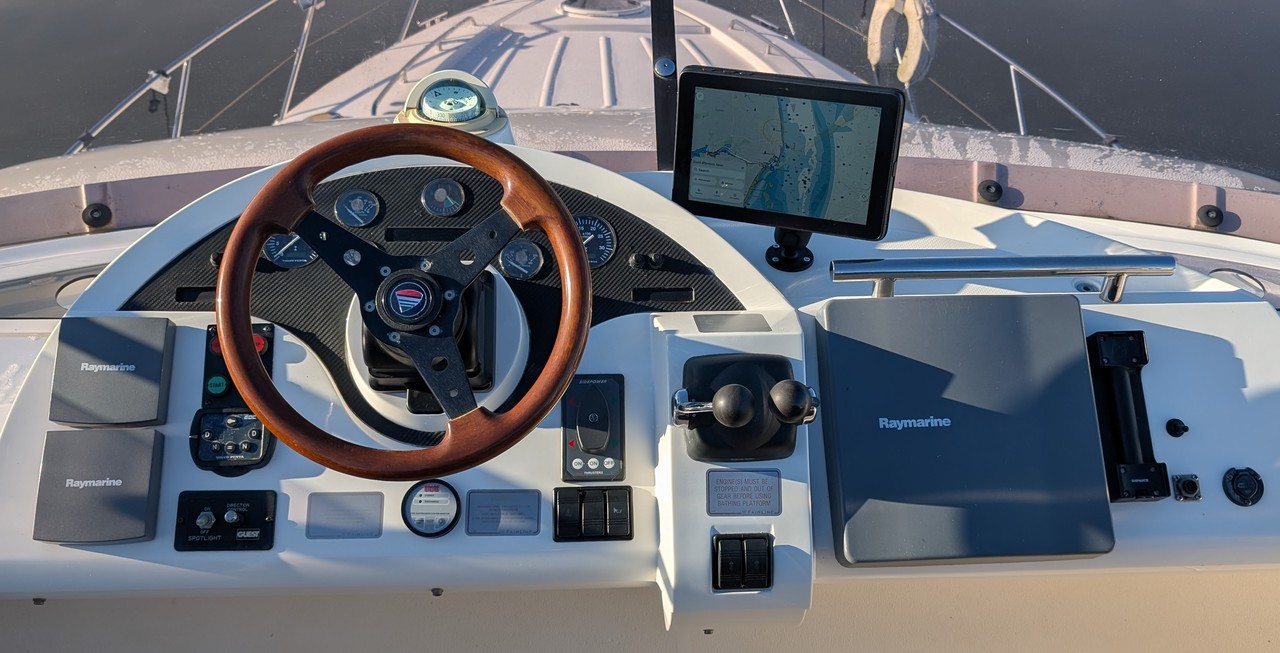
| Part 5: Reflections and Opinion I've just bought a boat that had even more primitive navigation equipment than my last one. Both boats are from the same era, but at least "Sand Dollar" had been fitted with a Raymarine e95 at the upper helm, so I could still get map updates and add equipment such as an AIS unit, albeit by a WiFi/NMEA 0183 adapter. My current boat is also a flybridge cruiser, but it was fitted with two original Raymarine Seatalk 1 / HSB combined 10" chart plotter / analogue radar units, with C-MAPs from 2005. Vital that I upgraded to something more modern.
I had a few dilemmas that must be quite common to owners of flybridge boats with legacy SeaTalk 1 systems:
- At the upper helm, my existing chartplotter/radar is quite large. Replacing it with a newer MFD means selecting one large enough to cover the hole in the dashboard that would be left when removing the old unit. In my case, this would mean selecting a 12” unit (~£2.5K). Alternatively, I could choose a smaller 9” MFD (~1.3K) and carry out fairly extensive repairs, or fit an unsightly panel to the dashboard.
- At the lower helm, I would not want to remove the old chartplotter as it doubles as a radar screen. There was one location where I could add a flush-mount MFD to the left of this unit, but it would mean relocating the Marine VHF Radio system that’s mounted behind that area. I can't put a unit to the right of the engine controls console because there's a slide-out-and-fold-down chart area on that side.
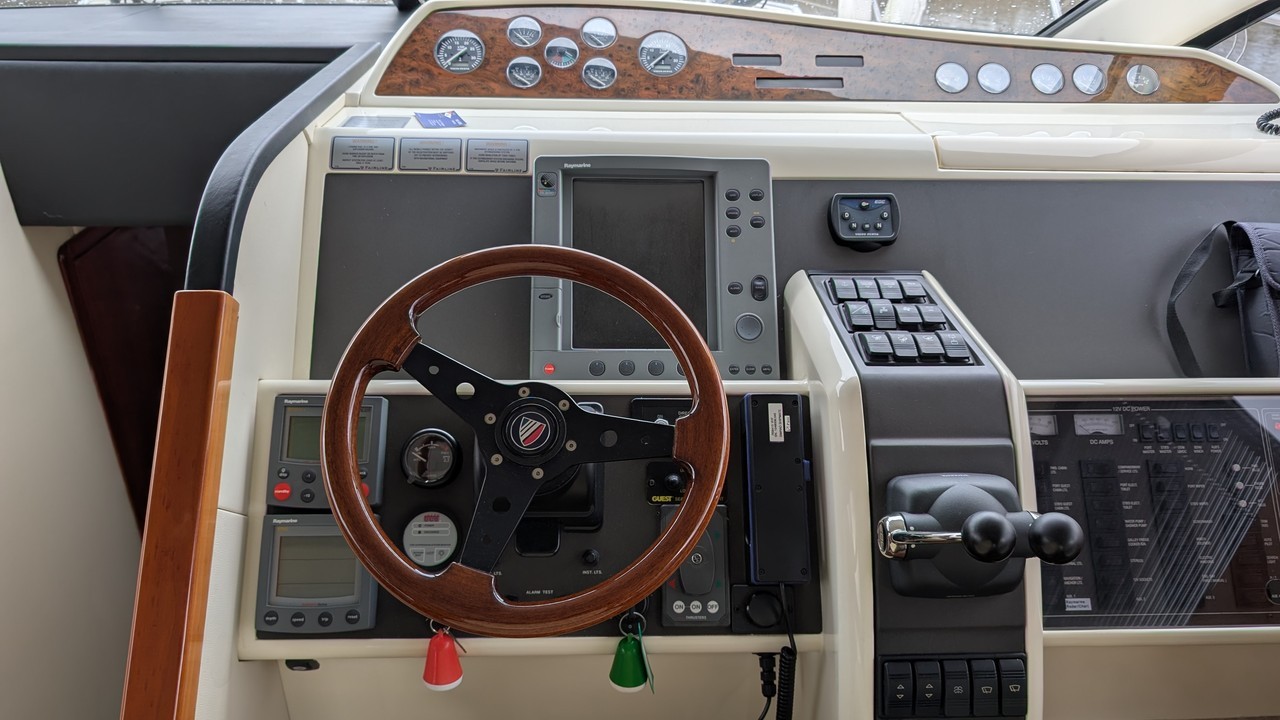 - At both helms, I could also consider fitting an external mount or enclosure for the 2nd chartplotter. This is not a bad option, and was in fact the approach used by one of the previous owners of my last boat on the upper helm. They connected an e95 chartplotter to the existing SeaTalk 1 network using an R52131 SeaTalkNG convertor powered by the SeaTalk 1 connection.
- As I wanted to fit an AIS unit, I would still need to route a SeaTalkNG or NMEA 2000 cable between the two helms to route AIS data. This might be avoided if I settled for only one new chartplotter (and fitted it near the same helm), but this this was a limitation on my previous boat that I wanted to avoid.
- The neatest solution would be to fit new 12” flush-mount MFDs at both locations, but this would mean losing the radar capability, or upgrading to a new digital radar at the same time. The main parts alone come to nearly £6400 before any installation costs. This would involve some extensive new cable routing between the upper and lower helms and it’s unlikely I would have seen much change from £10K by the time I’d finished.
I could have saved a bit of money by just upgrading the upper helm MFD and keeping the lower one purely for radar, as a previous owner of "Sand Dollar" had done, but I felt there must be a better, more modern solution. Thankfully, I had been following the introduction of the Orca navigation for some time, and had concluded that this was a more cost-effective and slicker solution. The Orca system appeared to offer several benefits: - The Orca Core 2 provides modern GPS and compass to the system (did I mention that the original Raymarine GPS takes forever to get a fix and loses it frequently?)
- The Orca Display 2 is portable, meaning I can keep it inside the boat for security and use it at the upper helm in its wireless charging mount.
- The Orca software runs on the Display 2, but also any recent Android/iOS phone/tablet, or Apple Macs running on Apple 'M' chip series.
- Any waypoints or routes that I create using any of these devices, will be automatically synchronised with the others when I switch them on.
- As an NMEA 2000 device, the Orca Core 2 can connect to my existing Raymarine 150 SeaTalk 1 autopilot via converters to SeaTalkNG and SeaTalk 1. This means that any new devices can be easily connected to the new NMEA 2000 backbone.
- I only have to pay one map subscription per year instead of two; previously I was paying for updated charts for my plotter, and a separate Play Store subscription for the Garmin/Navionics Boating App.
It seemed to be a win-win; significantly cheaper than a Raymarine upgrade or similar systems from the older established marine electronic manufacturers, in a nice modern package that's consistent with modern App interfaces. So here's how I got on... |
 Kevin Millican